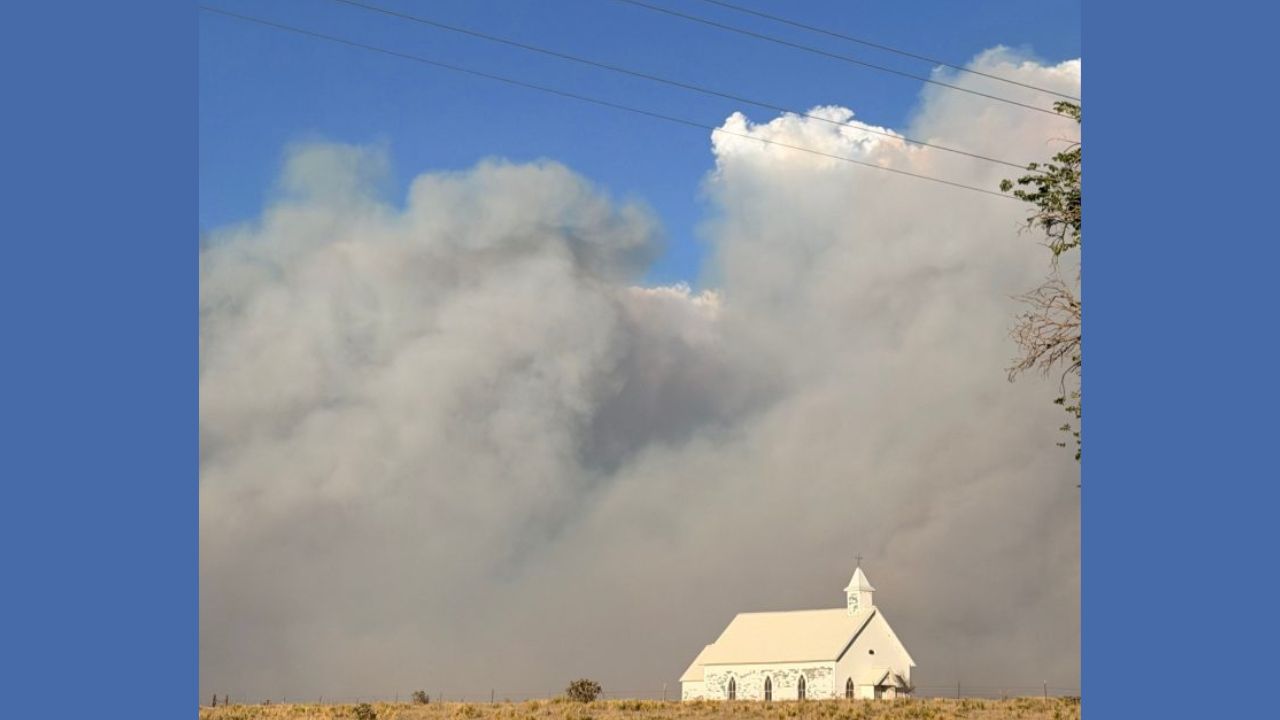
- A single lightning strike triggered the Line Fire on May 14, burning more than 30,000 acres across New Mexico’s eastern panhandle.
- Ranchers Kyle and Tonya Perez lost close to 30 miles of fence and 10,000 acres of pasture near Nara Visa, N.M.
- Their cattle survived by fleeing the flames on their own — while neighboring ranches were not as lucky.
- Weeks later, the family is still waiting on a disaster declaration as recovery costs pile up with no aid in sight.
NARA VISA, New Mexico — Kyle Perez was in the middle of breeding his last three cows when he smelled the smoke.
It was May 14. A single lightning bolt had struck nearby — one that, as Kyle put it, “didn’t have a bucket of water in it.” Within hours, that spark tore across the dry, wind-whipped landscape of eastern New Mexico and became the Line Fire.
By the end of the day, more than 30,000 acres were gone.
Why This Fire Spread So Fast
The land around Nara Visa had actually been thriving just months before.
Last summer brought more rain than usual. Grass grew thick and tall through the fall. Kyle and his family deliberately left that stockpile standing — a careful, long-practiced strategy to carry their herd through the next spring.
But the winter came dry. Then the spring came dry. And when the wind picked up on May 14, all that lush grass became the perfect fuel.
“We had green grass through the end of April, all the way into the fall,” Kyle said. “You try to take care of your land.”
That care made the fire worse, through no fault of their own.
Cows Walking Out of the Flames
With the fire bearing down, Kyle and his father Michael raced to move cattle and fight the fire with their own rigs. But the flames outpaced them fast.
The nearest fire department is roughly 40 minutes from the Perez ranch. Volunteers still have to drive in before the trucks even roll.
One group of Hereford cows was in a pasture that was set to receive embryos the following morning. Their pasture burned. Tonya captured the moment on video — the cows trotting out of the ash, flames behind them, bawling as they moved toward the feed truck’s familiar siren.
“I watched the fire blow over those cows and then it came back as the wind shifted,” Tonya said. “It’s a helpless feeling.”
Michael got trapped in the pasture during the chaos. The cows, essentially, saved themselves.
Neighbors Were Not as Lucky
The Perez family lost no cattle — a fact they credit partly to having large pastures with room to move.
Their neighbors were not as fortunate.
“Some of our neighbors had cattle that died and a lot of others that had to be put down,” Kyle said. Some animals were badly singed, their bags blistered, their feet burned.
The local veterinarian moved quickly, working with Zoetis to deliver cases of Draxxin to affected ranchers before the fire was even fully out — allowing mass treatment for respiratory distress on short notice.
Counting the Damage
Once the smoke cleared, the Perez family began the grim task of figuring out what they had lost.
Tonya turned to the mapping app OnX to trace every fenceline and pasture boundary. She created individual folders for each pasture, mapped the perimeter, the cross-fences, the traps — everything.
“We couldn’t drive all the fencelines we lost in three days,” she said. “This is an easy way to get an estimate.”
The total: nearly 30 miles of fence destroyed and roughly 10,000 acres of pasture burned.
“It basically burned to the irrigation circles and the blacktop,” Kyle said.
Waiting for Help That Has Not Come
More than two weeks after the fire, New Mexico Governor Michelle Lujan Grisham had still not approved a disaster declaration — even though it was submitted for her signature before May 26.
The fire also crossed into Texas, adding more complexity to securing state and federal aid.
The family estimates 55 to 60 fence corners will need to be replaced. No financial assistance has arrived. Tonya noted that limited firefighting resources in the area are also a major reason why a proposed National Interest Electric Transmission Corridor line running through the region makes no sense.
“The fire was the easiest part so far,” she said.
A Long Road Back
Kyle has already turned bulls back out on the herd and the ranch has received several inches of rain since the fire. But recovery will take years, not weeks.
“It’ll take a couple of years to get the turf back to where it once was,” he said. “We’re going to fight the sand, too, because it’s such a massive area.”
For now, the Perez family — like dozens of ranching families across eastern New Mexico — is rebuilding mile by mile, post by post, with no checks in the mail and no timeline for relief.
Have you or someone you know been affected by wildfires this season? Share what you’re seeing in the comments below.